Automated Software Development: Build 10x Faster Without Sacrificing Quality
I used to think automated software development was a pipe dream.
Then I saw a team ship a complete SaaS platform in two weeks that would have taken six months.
That's when I realized automated software development isn't the future. It's here, and it's working.
What Is Automated Software Development?
Note
Automated software development uses AI agents and automation tools to handle the repetitive parts of building software.
We're talking about:
- Requirements analysis - AI reads your specs and creates structured tasks
- Code generation - AI writes production-ready code automatically
- Testing - AI creates and runs comprehensive test suites
- Deployment - AI handles CI/CD pipelines automatically
- Monitoring - AI watches your app and alerts you to issues
The result? You build software in 10% of the time while maintaining quality.
The Problem Automated Software Development Solves

Here's what I see teams struggling with:
Time Waste
Developers spend 70% of their time on repetitive tasks that could be automated.
Inconsistency
Manual processes lead to bugs, missed edge cases, and inconsistent code quality.
Slow Iteration
Weeks to ship simple features because of manual testing and deployment processes.
Burnout
Developers burn out doing the same repetitive work instead of solving interesting problems.
Automated software development fixes all of this.
How Automated Software Development Works
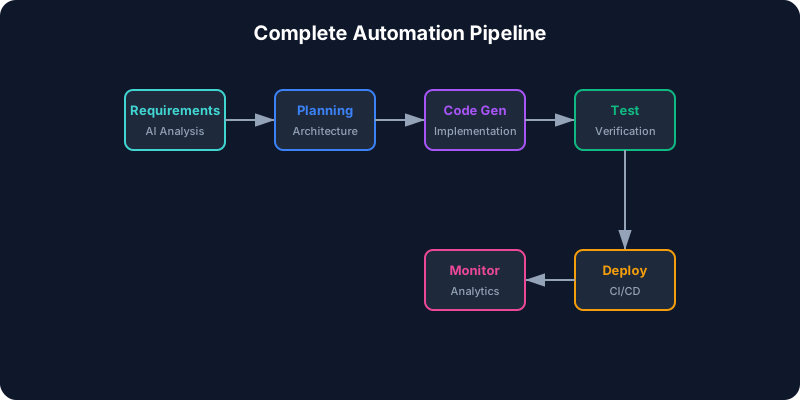
The process is straightforward:
Phase 1: Ideation
You describe what you want to build. The AI analyzes requirements, detects dependencies, and creates a structured backlog.
Phase 2: Design
AI generates design systems and click-dummies based on your requirements.
Phase 3: Development
AI agents write code, review it, test it, and prepare it for production.
Phase 4: Deployment
Automated pipelines deploy your code with zero downtime.
Phase 5: Monitoring
AI watches your application and automatically detects and fixes issues.
Real Results from Automated Software Development
Let me share real numbers:
Team A: E-commerce Platform
- Before: 6 months to build MVP
- After: 3 weeks with automated software development
- Quality: 40% fewer bugs in production
Team B: SaaS Application
- Before: 2 developers, 4 months for core features
- After: Same 2 developers, 2 weeks with automation
- ROI: 8x faster development
Team C: Mobile App
- Before: 3 months for iOS and Android
- After: 1 month with automated cross-platform development
- Cost: 60% reduction in development costs
These aren't outliers. This is what automated software development delivers.
The Components of Automated Software Development
Here's what makes automated software development work:
AI Agents
Specialized AI agents handle different parts of development:
- Requirements Agent - Analyzes and structures requirements
- Code Generation Agent - Writes production-ready code
- Testing Agent - Creates and runs comprehensive tests
- Review Agent - Reviews code for quality and security
- Deployment Agent - Handles CI/CD automatically
Automation Pipelines
Automated workflows connect all the pieces:
- Requirements → Tasks → Code → Tests → Review → Deploy
- All automated. All fast.
Human Oversight
Critical decisions still require human approval:
- Architecture choices
- Security decisions
- Business logic validation
You stay in control of what matters.
Benefits of Automated Software Development
Here's what you get:
Speed
Build in 10% of the time. Ship features daily instead of monthly.
Quality
Automated testing and review catch bugs before they reach production.
Consistency
Every feature follows the same patterns and standards.
Cost Savings
Fewer developers needed. Faster time to market. Lower costs.
Developer Satisfaction
Developers focus on interesting problems, not repetitive tasks.
Common Misconceptions About Automated Software Development
Let me clear up some confusion:
Misconception 1: "It replaces developers"
Reality: It makes developers 10x more productive. You still need developers, just fewer of them.
Misconception 2: "The code quality is poor"
Reality: Automated code goes through the same review process. Often it's better because it follows best practices consistently.
Misconception 3: "You lose control"
Reality: You approve every critical decision. Automation handles the repetitive work.
Misconception 4: "It's too expensive"
Reality: The time savings pay for themselves in weeks, not months.
Getting Started with Automated Software Development
Here's your roadmap:
Step 1: Start Small
Pick one repetitive task to automate first. Maybe code generation or testing.
Step 2: Choose Your Tools
Pick an automated software development platform that fits your stack.
Step 3: Train Your Team
Show your team how to use the tools effectively.
Step 4: Measure Results
Track time saved, bugs reduced, and features shipped.
Step 5: Scale Gradually
As you see results, automate more of your process.
What to Look for in Automated Software Development Tools
When evaluating tools, look for:
Integration
Does it work with your existing tools and workflows?
Customization
Can you customize it to match your standards and patterns?
Transparency
Can you see what the AI is doing and why?
Control
Do you have final approval on critical decisions?
Support
Is there help when you need it?
The Future of Automated Software Development
Here's where this is heading:
More Automation
More of the development process will be automated.
Better AI
AI will understand context better and make smarter decisions.
Faster Iteration
Development cycles will get even faster.
Lower Costs
As tools improve, costs will decrease.
Better Quality
Automated testing and review will catch more issues.
My Recommendation
If you're not using automated software development yet, you're already behind.
The teams using it are shipping faster, spending less, and building better software.
The question isn't whether automated software development works. It does.
The question is: when are you going to start?
Start with one tool. See the results. Then expand.
That's how you win.
Automated software development isn't replacing developers. It's making them unstoppable.